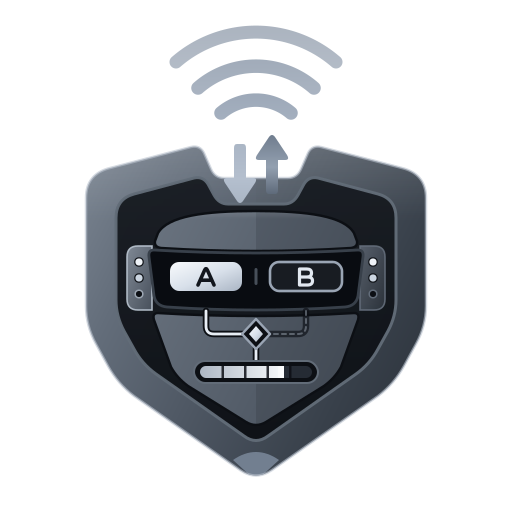
From signed release to updated robot over mTLS
Galvanize OTA separates where you store binaries, how releases are signed, and how robots verify what they install. Free for small teams that need it, hardened for scale and cost.
End-to-end delivery path
Every stage is isolated to your tenant. Robots never pull unsigned artifacts and never talk to the control plane without a tenant-issued client certificate.
 1. Package & Sign
Etch & Signing Vault
Hash release artifacts, build a manifest, and sign the SHA-256 digest with Ed25519 via your tenant Vault PKI.
 2. Store
Mines (Your Storage)
Binary payloads stay in your S3-compatible bucket, Google Cloud Storage, Artifactory, or Vault KV backend.
 3. Serve
Stockpiles
Per-tenant artifact server enforces storage quotas, validates robot mTLS certificates, and streams releases.
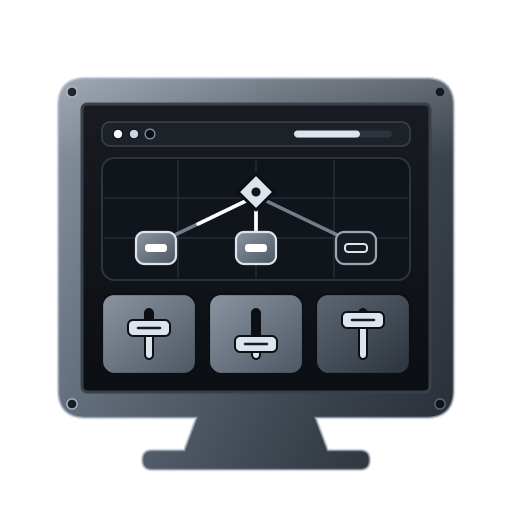 4. Target
Control Panel
Tenant portal and API assign campaigns by fleet percentage, issue enrollment tokens, and track robot health.
 5. Install over mTLS
Smithy (On-Robot Agent)
Polls on your schedule, checks signatures and downgrade rules, installs the update, and verifies health.
Safe updates and rollback
Smithy (the Rust agent running on each robot) polls your control plane on a configurable interval and pulls releases from your Stockpile using resumable byte-range HTTP downloads and zstd binary deltas. Before touching disk, Smithy checks the Ed25519 signature chain, verifies SHA-256 digests, and blocks downgrades against your fleet version ontology.
Typed installers handle rootfs images, Docker containers, SquashFS, tarballs, Linux kernels, ML models, and
calibration files. After installation, Hammer (the post-install health checker) validates
the update and triggers rollback on failure. For partition-level upgrades, Furnace and
Crucible (the bootloader and block-flashing libraries) include adapters for GRUB, U-Boot,
systemd-boot, and /dev/watchdog.
Campaigns roll a release out to a fleet or a single robot up to a target percentage cap (0 to 100%) and include an immediate kill switch to halt further installs.
Portal screenshot: Fleet campaigns and kill switch
Real portal capture will replace this slot after the portal UI cleanup.
Robot identity and isolation
Each robot enrolls once using a one-time token (stored only as a SHA-256 hash and burned on redemption) on a dedicated certless enrollment port. Smithy generates an ECDSA keypair and certificate signing request on the robot and receives a 1-year client certificate from your tenant's Vault PKI intermediate CA.
Every control-plane and Stockpile call after enrollment requires mTLS. Each certificate carries a tenant URI
Subject Alternative Name (urn:galvanize:tenant:<id>:robot:<chassis>) checked by
both services, so one tenant's robots cannot authenticate to another tenant's endpoints. Smithy checks
certificate expiry automatically and supports re-enrollment when rotating credentials.
Enrollment & transport defaults
- Enrollment token TTL: 5 minutes to 30 days (default 60 minutes)
- Client certificate lifetime: 1 year, tenant intermediate CA
- mTLS-only API listener fails closed if TLS config is absent
- Re-enrollment pins the new certificate and rejects superseded ones
Your storage, signed
Stockpiles are per-tenant artifact servers that robots connect to for manifests and payloads. Behind each Stockpile sit one or more Mines (pluggable storage backends) pointing to your AWS S3, Cloudflare R2, MinIO, DigitalOcean Spaces, Google Cloud Storage, JFrog Artifactory, or Vault KV store.
Manifests are signed with Ed25519 keys backed by short-lived X.509 leaf certificates from your tenant's signing vault, or with local keys and M-of-N multi-signature through Etch (the off-board packaging CLI). In the web portal, a WebAssembly trust module verifies signed manifests and diagnostic frames in the browser without exposing any private keys.
Portal screenshot: Stockpiles, Mines, and signed manifests
Real portal capture will replace this slot after the portal UI cleanup.
Access control and audit
Each customer tenant has its own subdomain with a web portal and REST/gRPC API. Operators sign in through OIDC SSO using Galvanize-hosted Auth0 or your own identity provider (Okta, Auth0, or generic OIDC), with MFA enforced by the IdP.
Galvanize staff have no standing access to customer tenants. Support and admin grants are requested just-in-time, time-boxed to 1 to 120 minutes, and require a second person to approve admin elevation (four-eyes). Every API and portal action writes to a SHA-256 hash-chained audit log retained indefinitely, with forwarding to Splunk HEC and OpenTelemetry trace propagation across updates.
Operational visibility
- Isolated tenant subdomain, database scope, and Vault PKI mount
- Tamper-evident SHA-256 hash chain with integrity check endpoint
- Splunk HEC SIEM forwarding with retry queue and test trigger
- OpenTelemetry OTLP trace IDs propagated to Smithy updates
Want to walk through Galvanize OTA with your fleet?
Tell us about your hardware, middleware, and robot count. Invite-only alpha tenants start free.